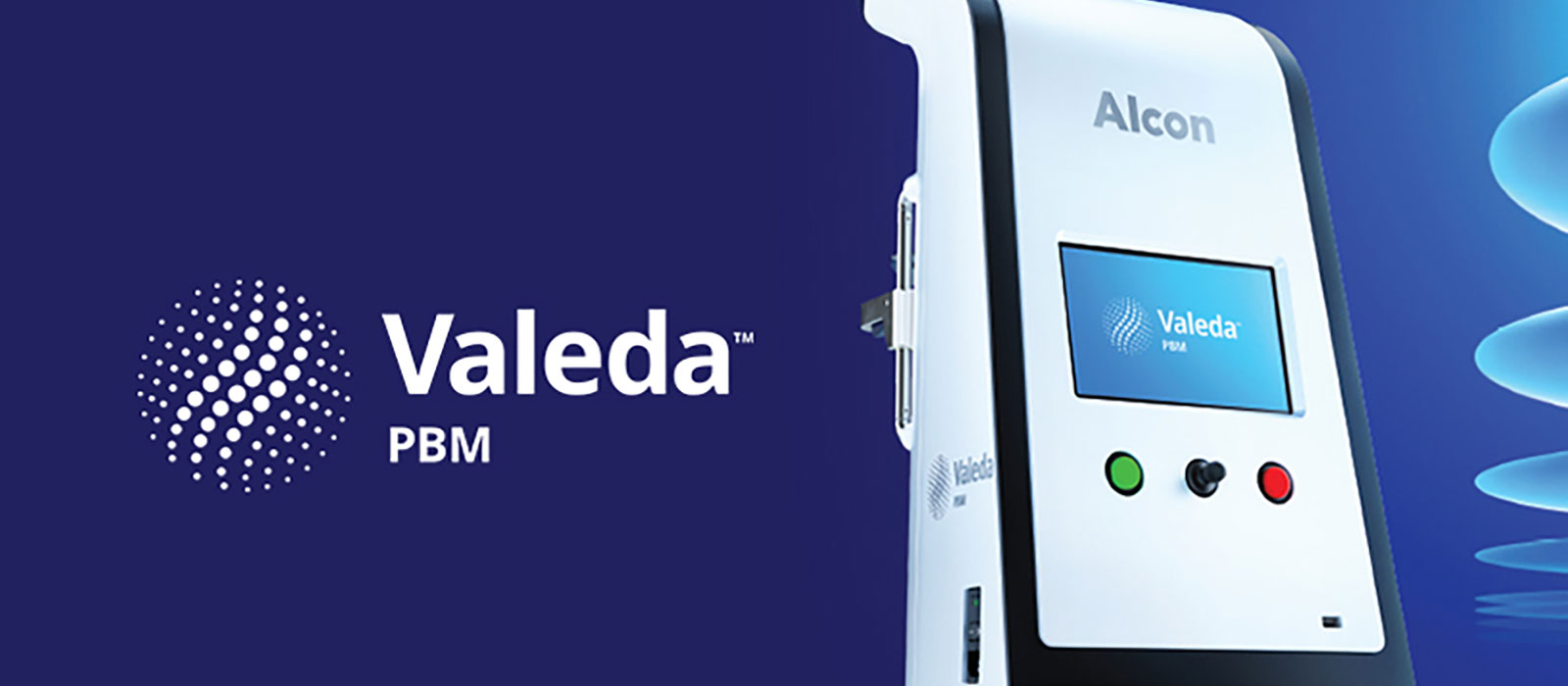



For decades, patients with dry age-related macular degeneration (AMD) were told there was nothing to do but monitor the condition, take vitamins, and wait. That has changed. Prairie Eye and LASIK Center now offers the Valeda® Light Delivery System, the first and only FDA-authorized treatment shown to improve and maintain vision in patients with dry AMD.
Valeda uses photobiomodulation, or PBM: a non-invasive light therapy that delivers specific wavelengths of light to the cells of the retina. There are no injections, no dilation, no anesthesia, and no eyelid speculum. Patients simply rest their chin on a support, look at a soft light for a few minutes, and go about their day.
The cells of the retina are among the most energy-hungry in the human body, and they depend on mitochondria to produce that energy. In dry AMD, mitochondrial function declines, cellular waste such as drusen accumulates, and the tissue of the macula gradually breaks down. The macula is the small central portion of the retina responsible for sharp, detailed vision–the vision used for reading, recognizing faces, and driving.
Valeda delivers three clinically studied wavelengths of light to the retina, each with a different role:
The goal of the therapy is to improve mitochondrial performance in the retina, reduce inflammation and cellular stress, and support the tissue that remains healthy.
The FDA granted marketing authorization for Valeda in November 2024, based largely on the LIGHTSITE III clinical trial and its extension studies. In that research:
Results vary from patient to patient, and Valeda is not a cure for macular degeneration. It is a treatment intended to improve visual function and help preserve the vision a patient still has.
Valeda is authorized for patients with dry age-related macular degeneration who have:
Patients with wet AMD, with advanced central atrophy, or with certain light-sensitizing medications or conditions may not be candidates. The only way to know is a dilated retinal examination with imaging. Our retina specialists at Prairie Retina Center will review your scans, stage your macular degeneration, and tell you plainly whether Valeda is appropriate for you.
A course of Valeda therapy is delivered as a short series of in-office sessions. Each session takes only a few minutes per eye. You remain seated, fully awake and comfortable, with no drops and no recovery time–most patients drive themselves home and return to normal activity immediately.
The full treatment regimen consists of 54 applications delivered over six courses across a two-year period, with each course spread over three to five weeks. Your doctor will map out the schedule at your consultation and monitor your vision and retinal imaging along the way.
Valeda does not replace the fundamentals of macular degeneration care. Nutrition, AREDS2 supplementation where appropriate, blood pressure and blood sugar control, smoking cessation, ultraviolet protection, and regular monitoring with an Amsler grid all still matter. Valeda is added to that foundation, not substituted for it. If your macular degeneration converts to the wet form, treatment shifts to anti-VEGF injections, which our retina team also provides.
Prairie Eye and LASIK Center serves patients throughout central Illinois from our offices in Springfield, Jacksonville, Hillsboro, and Decatur. If you have been diagnosed with dry macular degeneration–or if you have noticed blurring, distortion, or a dim spot in your central vision–we would like to evaluate whether Valeda light therapy is an option for you.
Call us at (217) 698-3030 or request an appointment online.
The Valeda Light Delivery System is authorized by the FDA to improve visual acuity in patients with dry age-related macular degeneration meeting specific clinical criteria. Individual results vary, and not every patient is a candidate. Valeda is not currently covered by Medicare or most commercial insurance plans; our staff will review the cost of treatment with you before you begin. This page is provided for general education and is not a substitute for a medical examination. Consult your ophthalmologist to determine whether Valeda photobiomodulation therapy is right for you.